

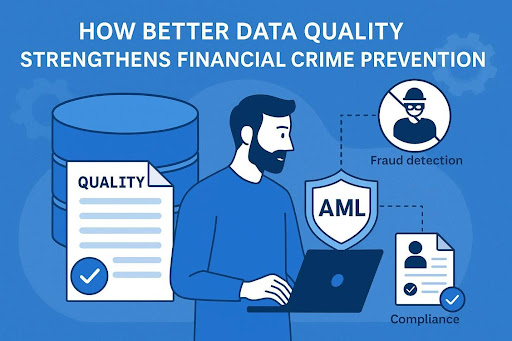
Financial crime is harder to detect today because criminals understand how monitoring systems work. They spread transactions across multiple entities, exploit gaps between payment platforms, and hide behind digital identities. Banks, fintech companies, and payment providers face pressure to stop this activity faster and with fewer errors.
A growing number of leaders are discovering that the most powerful fraud defense is not a new rule or a stricter form. It is cleaner, more consistent data.
High quality data fuels better screening, faster case decisions, and stronger compliance reporting. Poor data, however, slows everything down. Investigators struggle with mismatched fields, duplicated customer records, and missing context that should have been captured early.
This article explores how data consistency strengthens the financial crime lifecycle from onboarding to reporting. Along the way, it highlights practical steps financial institutions can take to reduce noise and increase certainty in their risk decisions.
Why data consistency is now a critical control
Banks have always needed accurate customer and transaction records. What changed is the speed and complexity of financial behavior.
Several trends make consistent data a necessity:
- Real time payments require real time risk checks
Instant transfers leave almost no room for slow data processing. - Cross border transactions add format diversity
Every region has different rules for data fields. - Fintech ecosystems grow rapidly
Shared services and third parties increase variation in how data is captured. - Synthetic identities are rising
Criminals combine real and fake details to fool systems that do not validate formats.
An inconsistency like a wrong date structure or missing country code may sound small. Yet it can prevent two systems from matching records correctly. In financial crime operations, that can allow a bad actor to slip through undetected.
Signs that data inconsistencies are harming compliance efforts
Common indicators include:
- High false positive rates in transaction monitoring tools
- Repeated manual corrections at investigation time
- Duplicate alerts involving the same customer with slightly different spellings
- Difficulty matching sanctions and PEP lists to customer profiles
- Relationship mapping that fails to show hidden risk linkages
- Increased regulator feedback about reporting gaps or errors
One of the most costly problems is operational drag. When analysts waste hours cleaning data, they have less time to investigate genuine threats.
How clean data improves fraud detection at every stage
Consistent data supports AML and fraud teams in four major ways.
1. Stronger identity validation
Upfront data checks help avoid onboarding clients with weak or missing details that criminals can exploit. Standardized field rules, dropdown language controls, and validation logic reduce risk long before monitoring begins.
Better identity data also improves entity resolution. Systems can spot relationships that humans would miss, such as shared devices or overlapping addresses.
2. More accurate risk scoring
Risk models need reliable inputs to deliver reliable outcomes. Clean data:
- Increases model confidence
- Reduces noise in behavior analysis
- Improves customer segmentation
This leads to smarter prioritization where investigators focus on the most suspicious activity.
3. Faster alert triage and case decisions
Investigators need full and clear information in one place. When data arrives clean and standardized:
- Cases open with correct context
- Fewer follow-up requests are needed
- Duplicate alerts drop significantly
Time saved here is a major cost advantage.
4. Better reporting and regulator confidence
Accuracy in Suspicious Matter Reports or AML filings is non negotiable. When institutions show a strong command of their data, they build trust and lower their risk of penalties.
A helpful resource explaining how standardized data improves reporting outcomes is found in Flagright’s article on data standardization for effective compliance reporting, which expands on practical standardization strategies for compliance teams.
Data issues that increase financial crime exposure
Not all data problems look dangerous on the surface. But criminals use them to create gaps.
Here are the worst offenders:
| Data Problem | What Can Happen |
| Free text fields for key identifiers | Name variations block matches and hide relationships |
| Outdated customer records | Models assign incorrect risk levels |
| Incomplete address and country details | Cross border activity goes undetected |
| Multiple formats for dates and amounts | Automated checks fail, forcing manual review |
| Unstructured transaction narratives | Investigators miss behavioral red flags |
| Duplicated profiles in different systems | Alerts appear harmless when split across identities |
Every one of these breakdowns weakens screening and surveillance.
Practical improvements that deliver fast results
Financial institutions do not need massive transformation to improve consistency. Small early wins can build momentum.
Standardize critical fields first
Focus on identifiers that drive AML screening:
- Legal name format
- Date of birth
- National ID fields
- Address structure including ISO country codes
- Account ownership fields
Even two or three structure improvements can noticeably reduce false positives.
Enforce real time validation
Stop bad data from being captured in the first place.
Examples include:
- No new profile without fully validated ID
- Automatic address formatting to postal standards
- Character limits and dropdown selections for risky fields
Frontline teams need tools that make the right action the easy action.
Deduplicate and unify profiles
Create a single customer view that:
- Connects all accounts and devices to the same entity
- Flags potential synthetic identity indicators
- Shows full transaction history across channels
Criminal networks thrive when institutions cannot join the dots.
Pair clean data with analytics
Standardization unlocks advanced monitoring, including:
- Graph analysis to reveal hidden networks
- Behavioral models for unusual transaction patterns
- AI assisted alert scoring for stronger prioritization
Technology performs best when the data behind it is well structured, which is why many institutions support these efforts with financial compliance software built to improve consistency, monitoring, and reporting in one place.
The long term payoff of consistent financial data
Improving data may feel like a back office project. In reality, it strengthens every part of business performance.
Here are major gains institutions report:
- Higher detection quality
More high risk cases caught early - Lower investigation workload
Analysts spend more time thinking and less time fixing errors - Greater regulatory trust
Fewer report rejections and faster approvals - Cost efficiency
Reduced waste in manual corrections and alert handling - Better customer experience
Legitimate clients face fewer delays and less friction
These outcomes support growth instead of blocking it.
Future risk challenges demand stronger data foundations
Financial crime teams are preparing for new threats like:
- Anonymous digital assets
- Real time international payments
- Money mule networks built on social engineering
- AI driven fraud that adapts faster than rules can update
Without consistent data, no monitoring tool can keep up.
Organizations that invest today in strong data foundations will react faster when new regulations or criminal tactics appear. Change becomes an update instead of a rebuild.
Leaders shift focus from more rules to better information
Some institutions try to improve detection by adding more rules. This often increases false positives because rules only see isolated behavior.
Data improvement works differently. It helps systems understand the full picture of a customer and their activity. That context makes risk analytics smarter and decisions clearer.
A single, validated version of truth creates confidence. Confidence leads to faster action. Faster action disrupts crime.
Building a data quality culture inside compliance teams
Tools help but culture drives success. The strongest data programs share three traits:
1. Ownership and accountability
Everyone who enters or uses data understands how their actions affect compliance outcomes.
2. Continuous improvement
Quality checks and feedback loops exist across onboarding, monitoring, and reporting.
3. Collaboration across functions
Risk, product, engineering, and operations teams work together on shared standards.
When teams speak the same data language, errors drop and clarity improves.
Cleaner data. Safer financial systems.
Financial crime prevention does not start with sophisticated models. It starts with consistent identifiers, accurate profiles, and clear transaction details that reflect reality.
Each institution that strengthens its data weakens the system that criminals depend on. The payoff is faster detection, wiser decision making, and stronger protection for customers and markets.
Compliance teams deserve tools and structures that let them focus on risk, not formatting. Clean data unlocks that future.
